By Michael Woyton
Someone get the Supreme Court justices a copy of the Constitution.
There is even a free app they can put on their smartphones.
Article I, Section 4 of the Constitution — otherwise known as The Elections Clause — gives the authority to regulate House and Senate elections to the state legislatures, according to the National Constitution Center.
FREE: Subscribe to On Second Thought now:
Yes, there are limits. The Elections Clause gives the ultimate power for regulating congressional elections to Congress, saying that it “may at any time by Law make or alter such Regulations.”
Who is not mentioned in The Elections Clause? The president and his desire to legislate through the use of a Sharpie and an executive order.
In March, president donald j. felon* issued an executive order restricting and centralizing control of how mail-in voting would be administered.
The mango mussolini has long blamed “rigged” mail-in voting for his 2020 defeat, without any evidence, and decided to have the Department of Homeland Security create lists of “eligible” voters state-by-state for federal elections. Additionally, he instructed the Justice Department to investigate and prosecute election officials who provide ballots to those voters the government says are ineligible and required the United States Postal Service to deliver ballots only to voters on the DHS’s pre-approved lists.
Democratic officials in 23 states and the District of Columbia sued, arguing that the states and Congress had the power to run elections, not the president.
On Monday, a majority of the Supreme Court “opened a path ,,. for possible implementation” of the president’s order, the Associated Press reported, “though it remains unclear how much can be put in place before the fast-approaching midterm elections.”
The 6-3 decision “didn’t decide the legality of Trump’s order, instead ruling that states who sued did not have the legal right to challenge it,” the AP said.
Basically, a majority of the court said that the executive order is really just a bunch of words that may or may not come to fruition and may or may not disinfranchise a lot of voters. Because they reached that decision, they have said that everything is speculation and therefore it can proceed. For now.
Additionally, the decision says that not allowing the president and his henchpeople to undermine the states’ right to oversee their elections “meddles in ‘the workings of’ the Executive Branch.”
So keeping the executive branch from doing something that is unconstitutional is “meddling.” Gotcha.
The Roberts court decision does actually admit it might be wrong.
“The Court’s disposition of this application does not mean that any measure taken by the Government to implement the Order will necessarily be lawful,” the decision said.
Gee thanks. That is small comfort 70 days before the midterms.
In her dissent, joined by Justice Elena Kagan, Justice Sonia Sotomayor in so many words called the decision bullshit.
She said, again in so many words, that there is enough “there” there in the president’s order to allow the states to immediately sue for relief right now and should not have to wait until the damage is done.
In a separate dissent, Justice Ketanji Brown Jackson pointed out the paradox that, historically, SCOTUS has held that even valid election-related legal claims can come too late.
“Today’s revelation is that such claims can also come too early — never mind that an election is looming and related harms are presently occurring,” Jackson wrote.
She pointed out that the president can only be “harmed by an injunction barring executive action if that court order is preventing him from doing something the law permits him to do.”
Jackson clearly states that the Constitution — remember the Constitution? — “plainly assigned the power to conduct federal elections to the States,” adding that the president “does not have any legal authority to require that elections be conducted in accordance with his preferences, or to withhold delivery of mail-in ballots that are not formatted” as the president wishes.
She is concise in her conclusion: “This is not a close call.”
Jackson wrote that the court should not have interfered with states’ constitutional rights.
“[I]t is both a serious legal error and a grave misuse of our equitable emergency powers to let the Executive proceed even one step further,” she said in her dissent.
There have been calls to not overreact to the decision from the Supremes.
Norm Eisen wrote on social media that there is more that can be done, particularly because SCOTUS said they simply said that the states which sued did so too early, before there was a final rule from the USPS.
“Now we HAVE a final rule & we will litigate it,” he wrote. “I’m as confident in our arguments here as in any of our cases!”
New York Attorney General Letitia James was quoted by the AP calling the decision a “painful setback.” However, she said “it would ‘not be the final word’.”
Whatever happens there will likely be chaos as states start ramping up election procedures for the November midterms.
The order from SCOTUS “effectively restarts the legal fight … in an incredibly compressed timeline,” PBS News said, “with initial ballots scheduled to be sent to North Carolina’s overseas and military voters in just over a week, on Sept. 4.”
The adjudicated rapist and convicted felon certainly accomplished one of his goals: to sow doubt and confusion in the electoral process.
And his corrupt buddies in the Supreme Court have shown no inclination so far to stop him.
— — — — —
* I’m following what the wannabe king declared on social media that he will only refer to the Supreme Court in lowercase because he has a complete lack of respect for them after the illegal tariffs ruling.
Find and follow me on BlueSky through this link.
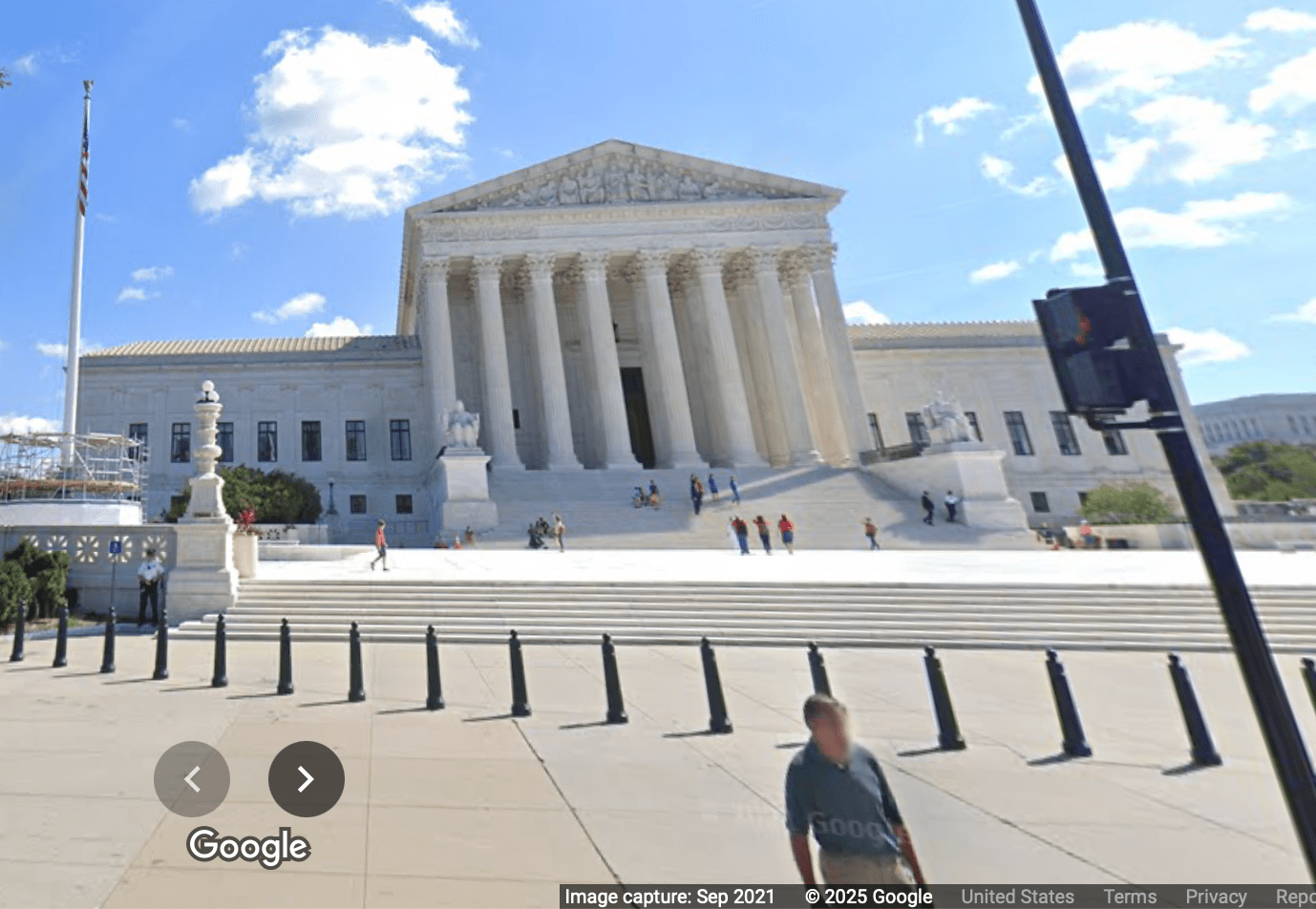
Lead art: screen grab from Google Maps.


One thought on “Felon’s SCOTUS Pals Need Refresher Course on Constitution”